The Sea Urchins – Pristine Christine
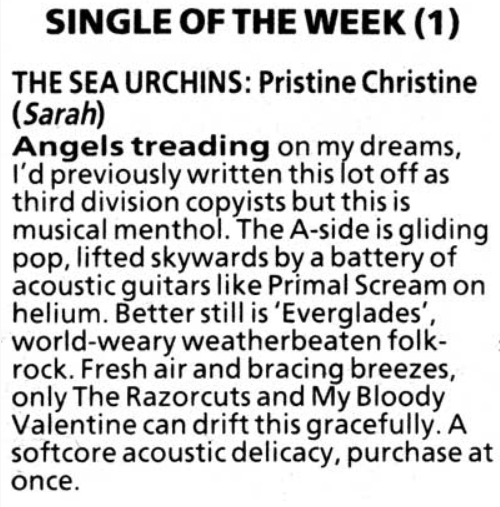
nme
The Wedding Present – A Million Miles It’s the lyrics, it’s the gorgeous melody, it’s the chiming layered guitars, it’s the overall pang of the joyous love that the whole thing evokes gedgesongs
The Cure – Catch captures the sensation of meeting someone you fall head over heels for right away, only for it to fizzle out before it even begins. The gentle violin sway conjures the hopeless, dizzy spell such an encounter can conjure, while Smith’s knowing tone recognizes that, later in life, you will look back and laugh at yourself, wistful but grateful you ever had such passions theringer
The Cure – Just Like Heaven Has any song ever sounded so gloriously, woozily in love? This is the bursting feeling that comes with infatuation at its most dizzying; there is sunlight in the guitar lines and Robert Smith smiles as he sings. The opening lyric is ecstatic and flirtatious and a little bit dirty all at once – “’Show me, show me, show me how you do that trick/The one that makes me scream’ she said.” Of course, there are the moments of insecurity, but this couldn’t be the Cure without the angst and besides, the band were the verge of boozily falling apart standard
The Jesus and Mary Chain – Darklands in 1987, the Mary Chain were bona fide pop stars, appearing on the cover of Smash Hits, and as recognisable to striplings taping the Top 40 off the radio as to the more earnest, NME-reading demographic that made up their fanbase… The consensus says Psychocandy is the masterpiece, but the Darklands LP, with April Skies and the tenebrous and gorgeous title track, has the better songs theguardian
R.E.M. – It’s The End Of The World As We Know It (And I Feel Fine) Sure it’s a little gimmicky, but sometimes gimmicks work. Windows down, with the tri-tone Monte Carlo overstuffed with my friends, this song was on repeat until we went all hoarse (ironically singing “It’s time I had some time alone.”) pastemagazine
Everybody thinks they know the words to this one, but after people blurt out “eye of the hurricane” they tend to get lost until “breathing down your neck.“… The day after George W. Bush got re-elected in 2004, R.E.M. played Madison Square Garden and opened with this song rollingstone
Dinosaur Jr – Little Fury Things acts as a mission statement for J Mascis, making rock’s creaking clichés sound expressive again by pulling them into new and different shapes. Sonic Youth’s Lee Ranaldo, an outspoken admirer of the Dinos, sits on backing vocals. The prodigious soloing and shredding on display feels like its being constantly marshalled by the group’s burgeoning instincts toward pop, giving the resulting mixture the feeling of being somewhere between Sabbath and Buzzcocks thestudentplaylist
Sonic Youth – Schizophrenia a sweet tune; disturbing lyrics – inspired by Gordon’s brother Keller’s struggles with mental illness – nonchalantly crooned; a fabulous, chilling vocal cameo by Gordon; pealing, wildly inventive guitar playing; and a lengthy slow-motion fade theguardian
The Smiths – Half A Person “Call me morbid, call me pale / I’ve spent six years on your trail.” A fragile shiver of a song – their funniest, saddest, most affectionate moment. Morrissey’s the stranger on the bus who tells you his life story – he runs away to London, he discovers all his small-town problems have come with him, he flees to the YWCA and tries to sign on as a back-scrubber. Morrissey and Marr wrote “Half a Person” face-to-face in a few minutes, ducking into the studio stairwell. “The best songwriting moment me and Morrissey ever had,” Marr told Smiths scholar Simon Goddard. “We were so close, practically touching. I could see him kind of willing me on, waiting to see what I was going to play. Then I could see him thinking, ‘That’s exactly where I was hoping you’d go.’ It was a fantastic shared moment.” It’s a moment we all share when we hear “Half a Person.” Any 10-second snippet of this song has more joy and anguish than most bands’ careers; the Smiths tucked it away on a B-side. Keats, Yeats and Wilde would all be proud rollingstone
The Smiths – Girlfriend In A Coma a song about how grief drops on your head when you’re not ready, as he murmurs, “Bye bye bye bye baby, goodbye.” rollingstone
Talulah Gosh – Talulah Gosh This is a world a million miles from today’s music. A world that is filled with anoraks, fanzines and enamel badges. Labelled as cutie, twee, with tra-la-la harmonies and by the standard of today’s music image spin doctors absolutely amateur. Part of the endearing quality of Talulah Gosh is its shambolic amateurishness. They were formed in 1985 when economics student Amelia Fletcher and struggling artist Elizabeth Price met at an Oxford indie disco; both were wearing Pastels badges, and they decided to form their own group teenageshoegazer
Elizabeth Price went on to win the 2012 Turner Prize, Fletcher, completed a D.Phil in economics at Oxford and joined the Office of Fair Trading where she became chief economist and director of mergers thequietus
The Rosehips – I Shouldn’t Have To Say They are very difficult to describe musically but the closest I could get is a cross between the Mary Chain (guitar) and the Shop Assistants (vocal) . The Rosehips sound like nobody really So Naive Fanzine
The Primitives – Stop Killing Me has the best use of tunefully sustained guitar feedback in a pop song ever (possibly).
They accidentally appealed to a wide demographic; “old” punks wanting a Ramones/Blondie amalgam, young kids wanting a new cool alternative that was immediately accessible and hipsters wanting the druggy cool of the Velvets and psychedelia. The sun, flowers, wind, and the ocean crop up in the lyrics, every other song seems to be about lazy stoned afternoons doing nothing… they were just a simple pleasure. A manic thrill, and in retrospect, at their absolute best before they signed to RCA…Crash was a hit and deservedly so, but somehow they went into a gradual decline from thereon in louderthanwar
The Pastels – Crawl Babies I was a teenager in the 80’s. Younger friends tend to exercise their chuckle muscles at my expense as they associate me with big hair, shoulder pads and dreadful England football teams losing to all and sundry as their fans wrecked the latest tiny country to exact revenge. It was all so odd and made worse by radio stations who could not decide between the bleeps and bloops of synth-pop or the smooth lusciousness of various new romantic type acts.
However, for some those in the know, bands like The Pastels and indeed the C86 movement in general, provided the perfect comeback for when the giggles reach a crescendo. For The Pastels were, are and probably always will be, the perfect retort to 80’s ridicule.
So what makes them so defiantly cool? Initially tracks such as Crawl Babies have that Martin Newell / Cleaners From Venus aesthetic that not only embraces all things lo-fi, but also has full blown intercourse with it, in the quest for ‘maximal amateurish’.
It the sort of indefinable cool that the naughty kid achieves when finishing top of the class despite never listening or studying. Essentially it is indie-pop with minimum effort and maximum impact as typified by the fluttering, unobtrusive jangle-pop that is off the key points remembered in each track. janglepophub
The Vaselines – Son Of A Gun one of the best examples you can find of a band becoming more famous and influential long after they had called it a day.
The three songs that made up the debut EP encapsulate everything that made the band so different from their late 80s peers while also demonstrating how it was difficult for anyone to find a single reference point with which to compare them… the lead track has aged magnificently, sounding really fresh and invigorating more than 30 years on, one which has no problem in filling the floor of your average indie/alt disco with even the young ones appreciating its charm thenewvinylvillain
The Stone Roses – Sally Cinnamon the first single that really mattered from The Stone Roses. Recorded two years before that eponymous first album, everything that made that record so cherished – the 60s-influenced guitar licks, the starry-eyed bliss of falling in love – is there in that 7” classicpopmag
The House of Love – Shine On Before their career faltered exactly at the point it should have been taking off, the House of Love seemed set to be the defining British guitar band of the late 80s. The measure of their brilliance – not too strong a word – is they could slip out Shine On and 1988 John Peel Festive 50 winner Destroy the Heart as single-only releases without compromising the quality of the album at all. … Here was a band who knew just how good they were – Guy Chadwick’s songwriting could border on florid, but the grandeur of the performances suits it to a tee theguardian
The Railway Children – Brighter just one of a string of successful independent bands poached and groomed for obscurity by the majors in the second half of the ’80s. Anyone jonesing for, ironically, something close to the Postcard sound?sparkling guitars, a melancholy, yearning tenor?will swoon for this … especially the irresistible lilt of “Brighter”. You’d think, given the Coldplay/Keane hegemony, there’d be an audience for this superior version: gentle, epic music but, here, with a soul uncut
The Chesterfields – Ask Johnny Dee If anyone ever asks you to suggest a quintessentially indie album then Kettle by The Chesterfields is most surely the perfect example. Released during the indie heyday of NME’s C-86/87 movement, Yeovil’s finest pop charmers turned in an absolute blinder with their debut record. Think Housemartins without the car coats or The Smiths at 78 rpm. High on hooks but short on seconds, The Chesterfields first platter speeds by in a fun-filled twenty-six minutes, but with enough melody to fill a football stadium.
1987 was a very good year for indie bands as that NME C-86 cassette kindly opened the basement door to a tribe of Transit hopping hopefuls. Venues across the UK were suddenly reverberating with the sound of independent bands. Some good, some not so, but The Chesterfields were notable because they excelled at indie pop and made it all seem so effortless in the process.
perhaps the indie anthem from that golden summer of 1987. Well it was the indie anthem in my bedroom, that’s for sure. Remember, this was the year that both The Smiths and Madness broke up. But The Chesterfields rose to the challenge of replacing both for me. Ask Johnny Dee sums up a special place in time and is still fondly remembered by the Chesterfield faithful as the song laments more lost love and is topped off by sparkling guitars and a hopeful ‘Ba Ba Ba Ba’ vocal hook nakedrecordclub
Pulp – I Want You Pulp’s luckless 1980s career has been dismissed as juvenilia – not least by Jarvis Cocker – but it’s sparingly studded with great songs, albeit great songs hampered by their ultra-cheap production. I Want You, from their second album Freaks, the kind of epic ballad they would later master with Something Changed, is a perfect example guardian
The Fall – Hit The North Infectious, spliced with electronics and tailored to the dance floor, the song took breaks from its singalong chorus to let Smith mumble warningly about “the reflected mirror of delirium.” rollingstone
New Order – Temptation Multiple versions have been recorded by the band over the years, but we’re going with the ’87 studio recording from the Substance compilation (the one you have on your Trainspotting soundtrack). In a single swoop, they were a thousand miles away from Joy Division, or even earlier Ian Curtis-influenced New Order releases. “Temptation” removed any remaining eyeliner from the band’s identity and brought them out into the sunlight. Pat yourself on the back if you’ve ever danced straight through its entire runtime. You’ve earned it consequence
Pet Shop Boys – It’s A Sin inspired by Tennant’s Catholic schooling, not a particularly obvious subject for such a huge hit. What makes the song work, though, is its overblown production, which makes sinfulness sound like the most thrilling thing in the world. Case in point: the muffled vocals at the beginning are from a Nasa countdown, for no other reason than drama guardian
U2 – I Still Haven’t Found What I’m Looking For The gospel inflections and earnest tone are precisely the kind of thing that winds up U2’s detractors. But blessed with a melody that sounds it has somehow always existed, its strength lies in the fact that it doesn’t deal in pious sermonising; its expressions of spiritual doubt are disarmingly heartfelt theguardian
The Hangman’s Beautiful Daughter – Love Is Blue A raga-rock circularity. Finger cymbals. A distant, etiolated female vocal. A fuggy atmosphere. A kinship with Jefferson Airplane’s “Come Up The Years”, The Jesus and Mary Chain’s “Just Like Honey” and The Velvet Underground’s “All Tomorrow’s Parties”. Hangman’s Beautiful Daughters’ “Love is Blue” is a beautiful, haunting recording.
Contrary to their Incredible String Band-derived name, they weren’t oddball folkies but instead chimed with contemporaneous Sixties-informed fellow travellers like Felt, the Jesus and Mary Chain and Television Personalities. Indeed, the latter’s Dan Treacy wrote or co-wrote three of their songs (he wrote “Love is Blue” with the band’s Emily aka Emilee Brown), produced them and issued their records on his Dreamworld label theartsdesk
The Siddeleys – What Went Wrong This Time? gentle teasing lament… which tickles around the nervous system with deceptive charm nme
The Brilliant Corners – Delilah Sands Perhaps it was just my particular social circle this applied to, but way back when The Brilliant Corners pestered the indie charts, there was a sense that they were very much seen as a novelty twee band. Unlike the bands on Sarah Records who supposedly meant every gentle word they frailly breathed, Davey Woodward’s gang seemed to be perceived as a bunch of piss-taking bastards from Bristol who would churn out observations such as: “We fumbled around in front of the budgie/ she started to laugh – what was so funny?”
the track has a spring and bounce which is immediately endearing, and substitutes the usual humour for lyrical peculiarities. “I’d bite you if I had the teeth” sings Davey Woodward bizarrely, which is almost evidence itself of the fact that they enjoyed taking the idea of grotesque outsiderdom to ridiculous extremes. If Morrissey was going to pretend to need a hearing aid, they’d simply pretend their lack of teeth let them down in the bedroom. Top that, ugly girl/ boy.
The video for this ended up being played as part of the Chart Show Indie Chart, leading my mother to comment: “Ooh, who is this? Is it Roxy Music? Well, I don’t like it anyway”. For years since I’ve been trying to work out what the hell she was talking about, as well as squinting my eyes to ascertain any possible resemblance between Bryan Ferry and Davey Woodward, so perhaps one of you can enlighten me left-and-to-the-back
The Motorcycle Boy – Big Rock Candy Mountain speed pop that hurtles full-tilt, frank and furious, without apologies nme
Aztec Camera – Somewhere In My Heart a heartfelt but colorless Philly soul record made with studio musicians and half a dozen producers. (Think of Boy George or Paul Young, with music supplied by Steve Winwood.) Although Frame’s singing and songwriting don’t quite suit this musical style, his low-key charm and basic talent keep him from embarrassing himself trouserpress
The Housemartins – Five Get over Excited they would provide conclusive proof that a band of completely normal dudes could emerge and gain respect for singing their hearts out about what means most to them, and that this could be done without any pomp involved lonelytable
BMX Bandits – The Day Before Tomorrow this wistful ballad typified the wry humour and songwriting nous of Stewart, who was Galsgow’s answer to Jonathan Richman
The Heart Throbs – Try one of those indie-bands from the late 80s/early 90s who don’t seem to generate too much in the way of nostalgic musings across t’internet. They were too late (and too professional) for the C86 movement and its aftermath and they didn’t move their sound on in any great way to be lumped in with the sort of music associated with baggy/Madchester. There was also, perhaps, something of a suspicion of nepotism getting the band to places where others hadn’t been able to reach on the grounds that two members of The Heart Throbs were sisters of Bunnymen drummer, Pete de Freitas thenewvinylvillain
The Weather Prophets – She Comes From The Rain spiralling guitars and a lovelorn theme similar to Primal Scream’s ‘Velocity Girl’ C87 liner notes
The Go-Betweens – Bye Bye Pride For a lost-love song sounds positively joyous… it’s probably reductive to call “Bye Bye Pride” a mere breakup song, residing as it does in that Go-Betweens land of messy grown-up love where nothing is ever quite finished and it’s hard to remember exactly how it began. As usual, McLennan’s lyrics veer from the striking but opaque to the direct. It’s hard to know what to make of “In the Parisi della Palma, a teenage Rasputin takes the sting from a gin,” but the lines that immediately follow — “When a woman learns to walk she’s not dependent anymore/A line from her letter, May 24” — are personal and specific, especially since McLennan makes it clear that it’s fine with him if said woman uses her newfound feet to march directly into the sea. You know he both means it and doesn’t, which is the beauty of the Go-Betweens and of this heartbroken, ecstatic song. allmusic
Close Lobsters – I Kiss The Flowers In Bloom released in late 1987 to lukewarm response in a U.K. press already tired of the C-86 propaganda, but its inviting mix of jangle pop, hazy psychedelia, inscrutable lyrics, and monster guitar hooks gained Close Lobsters a small but fervent following on the U.S. college radio scene allmusic
Guns N’Roses – Paradise City lives and dies on the strength of its chorus – and what a chorus. “Take me down to the paradise city, where the grass is green and the girls are pretty” is so ingrained in pop culture that children know it before they know about the band that wrote it. The hard rock breakdowns obviously hit hard as well – even if they jar just slightly when cast against the folk-like melody that made this piece immortal theguardian
The Wedding Present – My Favourite Dress When George Best was released on October 12, 1987, it was an event, in indie terms. It was the big display item in independent record shops; the early copies came a George Best carrier bag and a white vinyl 7″ of ‘My Favourite Dress’. The Wedding Present were rewarded with a No 47 placing in the album chart, the real chart. That doesn’t sound like much now but for an indie group in 1987 it wasn’t far short of the achievements of Alexander The Great…
Hindsight, of course, is easy. George Best‘s conservatism didn’t seem quite so evident at the time. Perhaps those of us who loved The Wedding Present were aware that they could never equal The Smiths, melodically or lyrically. But they were what we needed at the time, a band who very clearly spoke for the “us” who were morally opposed to music that made its practitioners into superheroes, who were crap with the opposite sex and unsure about what place we were meant to carve in the world. The musical certainty of George Best gave us what we craved, and the excitement of rushing guitars into the bargain.
The thing we should have noticed, really, was how male it all was… On the one hand, the maleness is unavoidable. Gedge, a limited singer, could never sound like anything other than what he was: a bloke from the north. And the music – forthright, loud and sometimes clunky – was what brought in the geezers (and come they did; I recall one show in Leeds, a benefit for Nicaragua, that descended into a face-off between the university rugby league team and a busload of Manchester United fans who’d come over the Pennines looking for a scrap). But it was not wholly unavoidable: the lyrics to George Best deserve some attention.
It’s clear that Gedge is sometimes writing in character, and that the character isn’t always meant to be sympathetic. But no matter who the protagonist is in any song on George Best, he is always disappointed by women, and women exist in these songs only in terms of their effect on the mental wellbeing of men. It’s an almost Saudi view of things. There are two kinds of women in the songs of George Best: the ones who betray, and the ones who are so without agency that they stick with terrible boyfriends, even though David’s here and he’s so much nicer.
It’s a perfectly reasonable position to argue that when one is writing songs about heartbreak, then it’s natural that the focus of the songs will be the feelings of the heartbroken person. But, as with regards to the music, the sameyness becomes the issue. In real life, when one meets a man who seems perpetually to be complaining about their mistreatment by women, one starts noting that the common factor in all these break-ups is them, and begins to wonder quite what he does that makes women leave with such frequency.
Gedge was a young man when he wrote those lyrics. I suspect he would not write them now. And this is with the benefit of a) hindsight b) the perspective of having known a great many more women (and had more relationships) than I did when I was 18, obsessing over George Best and c) the significantly greater awareness of male privilege that I now have. Nevertheless, lyrics that seemed to me at the time to be an admirably moralistic view of human relationships now seem angry and judgmental; the line in ‘My Favourite Dress’ that “jealousy is an essential part of love” is the one that sums up the worldview of these songs. It’s worth remembering, though, that these are songs of youth: my perception of them has changed as I have got older. I fully empathised with that view of jealousy and love when I was 18, but now I have been married for 20 years. I would not be in the least surprised if Gedge looked at some of those lyrics and wondered what on earth he’d been thinking.
If the late mid-to-late 80s was when indie became codified as, fundamentally, “music played on guitars by young white men” – we can quibble around the edges, but that’s the long and the short of it – then The Wedding Present became, for better or worse, its standard bearers. The sweep of a long and interesting career – experiments with noise, lofi, Ukrainian folk music – is reduced to this: lovelorn blokes playing loud. I wish that weren’t the case, for The Wedding Present were for a long time my favourite band, but that’s the truth. By making something that had the laudable aim of being non-elitist, The Wedding Present helped dig the hole that became the indie landfill. thequietus
The Corn Dollies – Be Small Again there was one band, London based The Corn Dollies, who foracouple of years were deemed the most important live act of the era.
This was apparent to such an extent that I vividly remember my lot trying to swiftly sell tickets to see The Smiths in London as ‘The Dollies’ had announced a hastily arranged gig at some dingy pub basement in Birmingham, only to find that all the fans of The Smiths that I knew in my town were trying to do the same thing ! They truly were these most vibrant live band of the 80’s jangle-pop era and seemed to gig at least 20 times a week ! They seemed to have that indefinable connection with their audience that is not easily explained. You, the band and the remaining audience just felt part of one big secret that you hoped would never be found out, but equally hoped an increasing number of people would organically stumble upon.
It was perhaps the fact that they were so in demand on a live basis and presumably felt that ensuring that they continued to increase there fan base via gigs would be the vehicle to turn their live appeal into eventual commercial success, that eventually prevented them from releasing the volume of studio output that their music deserved. It was essentially a live juggernaut they did not have time to stop.
these tracks remind me of countless gleeful, sweaty hours in the mosh-pit and a hundred train journeys home, hiding in toilets or using distraction tactics such as fake fights to avoid/distract the ticket inspector. janglepophub
Happy Mondays – Twenty Four Hour Party People this storming tribute to hedonism… also gave its name to the rather excellent biopic of Factory Records radiox
This Poison! – Poised Over The Pause Button like music made in the operating area of a hundred lathes nme
Hüsker Dü – Charity, Chastity, Prudence and Hope Never had a band so spectacularly fallen apart the minute they were given the opportunity to succeed… Husker Du had drug problems, personal antagonism, internal tragedy, and pure exhaustion to blame for their own implosion, right as the world was beginning to embrace the exact kind of music they were playing.
Both Mould and Hart had so enough amazing songs to fill out full albums each, so Warehouse became a double album featuring alternating song credits… What followed the album’s release is a sad and bizarre string of events: their manager David Savoy took his own life right before the supporting tour kicked off, leading Mould to take control to the consternation of Hart. Hart was in the throes of a heroin addiction that made his playing and behaviour unpredictable. The band played on The Today Show and The Late Show Starring Joan Rivers, for inexplicable and unexplainable reasons. When Hart and Mould came to blows over Hart’s abilities to play clean, the three parted ways and permanently closed the door on Husker Du. It was a sad ending to an amazing band, but the joys and triumphs of a legendary band could still be heard, and if you want to find that joy for yourself, it’s hard to find it in a better place than Hart’s ‘Charity, Chastity, Prudence, and Hope.’ faroutmagazine
Pixies – The Holiday Song Frantic flamenco-tinted surf-pop hysteria about Biblical incest, it was essentially the Monkees with rabies and the perfect song to play around the beach campfire after a long day catching waves, just as the batch of brown acid kicks in guardian
14 Iced Bears – Balloon Song A quick scoot over to Wikipedia should provide anyone in need of some background on 14 Iced Bears with a salient amount of valuable data. On there you’ll discover 14 Iced Bears were a British indie pop band associated with the C86 music scene… 14 Iced Bears have remained firmly in people’s consciousness, even to this day. The reason for that is really rather clear to us. They made fantastic music and that sort of thing you won’t learn from Wikipedia everythingindieover40
The Darling Buds – If I Said Without Transvision Vamp’s vanity or The Primitives’ coolness, The Darling Buds were foiled by their own unwillingness to shout about themselves within the so-called ‘blonde’ movement in late-80s guitar pop classicpopmag
The Waltones – She Looks Right Through Me a marvel of plaintive vocal and chiming guitar scaredtogethappy
Miaow – When It All Comes Down Championed in Smiths-era indiedom by the very paper she wrote for, former NME hack Cath Carroll’s Miaow built their cult upon just three EPs before disbanding… nothing eclipses this … jangle-tastic Factory single with its blissful Tyrolean yodel and glam hand claps uncut
Whitney Houston – I Wanna Dance With Somebody (Who Loves Me) Plenty of objections have been raised about Houston’s 80s oeuvre – too soft, too calculated, too eager to reach a white audience – but it’s a total curmudgeon who doesn’t feel their heart lift a fraction when I Wanna Dance With Somebody bounds joyfully out of the speakers – irresistible instant sunshine in musical form theguardian
Tiffany – I Think We’re Alone Now Tiffany’s take on “I Think We’re Alone Now” is nothing like the Tommy James And The Shondells version. Tommy James sings that song with a harried, almost fearful sort of desperation. He sounds like he’s taking a big risk in looking for a place to be alone with a significant other. The music reflects that horny anguish, and it drops into a hush on the chorus.
By contrast, Tiffany sings the song with a confident, booming bellow, a sort of unformed teenage take on Stevie Nicks’ mystic rasp. Tiffany doesn’t sound like she’s worried about being caught. She sounds like she’s taking complete control of the situation. Tiffany doesn’t modulate her singing, the way James does, but I love the way she belts out the “tried to get away into the niiiight” bit. She sounds like she’s really not worried about whether or not they’re alone now.
George Tobin’s production is a cheap, blippy thump that’s not terribly far-removed from hi-NRG. Everything other than Tiffany’s voice seems to be fully synthesized. There’s no real dynamic range to the song. On the chorus, Tobin doesn’t let everything drop away. Instead, it keeps up its same generically energetic boom throughout. As a result, Tiffany’s version of the song lacks drama. But in its cheap and low-key way, it still mostly works. That melody pairs delightfully with those lyrics, and the rawness of Tiffany’s voice helps things. When you’ve got teenagers singing about teenage things, it’s fine for the end product to sound a bit unprofessional. It adds to the charm of the thing. stereogum
Bill Medley & Jennifer Warnes – (I’ve Had) The Time Of My Life Johnny walks over to where Baby sits with her family and tells her father that nobody puts Baby in the corner. Then he takes her by the hand, leading her onstage and interrupting that camp song. He tells the audience that he always does the last dance of the season. He’s going to do his kind of dancing with a great partner — someone who’s taught him about the kind of person that he wants to be. Then one of Johnny’s friends drops the needle on a 45 that couldn’t possibly have existed in the summer of 1963.
What happens next is pure romantic delirium. The song starts up, all keyboard tones and ’80s drum sounds, and Johnny and Baby melt into each other, moving as one and transforming into a blur of motion. Johnny leaps offstage in ecstatic slow-motion, and Baby throws her head back in delight. Johnny twirls on his knees and headbangs while jumping. He joins his co-workers in a choreographed strut, moving toward Baby like he’s in a Michael Jackson video. Baby runs toward Johnny, and they do the Lift, the move they’ve been working on all summer. They pull it off, and the audience loses its collective mind.
By the time the extremely long and anachronistic song ends, everyone in the ballroom has a whole new perspective. Old ladies are dancing. The owner of the resort is dancing. Baby’s mom is dancing. The house band joins in. Baby’s father admits to Johnny that he was wrong. Johnny lip-syncs along with a song that will not exist for another 24 years. It’s absurd, and it’s beautiful stereogum
 Keep Pollution Tidy